

MATERIALS & FINISH
Material Selection and a Black Finish
At first, I imagined a combination of silver aluminum profiles and walnut-veneered plywood. It was an easy—or at least relatively easy—safe and attractive choice. I very nearly settled on it.
The final result, however, was finished in black and dark gray. This was not simply because I like black.
Once the structure had largely been resolved, the decisions that occupied me for the longest time concerned materials and finishes.
The natural silver color of aluminum expresses the character of the profiles honestly. Walnut veneer is also my favorite wood tone and seemed likely to suit the atmosphere of the workshop. Another considerable advantage was the relative ease of fabrication: aluminum-profile furniture can be made by cutting components to size, connecting them, and assembling the structure without extensive secondary finishing.
Unlike the common pairing of aluminum profiles and birch plywood, adding walnut veneer also gave the workbench a heavier and somewhat fresher appearance. I continued developing this combination until shortly before the final proposal.
It was an attractive pairing that would have been difficult to get wrong, yet something still felt just slightly unresolved. Perhaps it was the visual lightness of the aluminum. Or perhaps I had been searching for a more distinctive appearance—something that would not look entirely at home in a conventional woodworking studio.
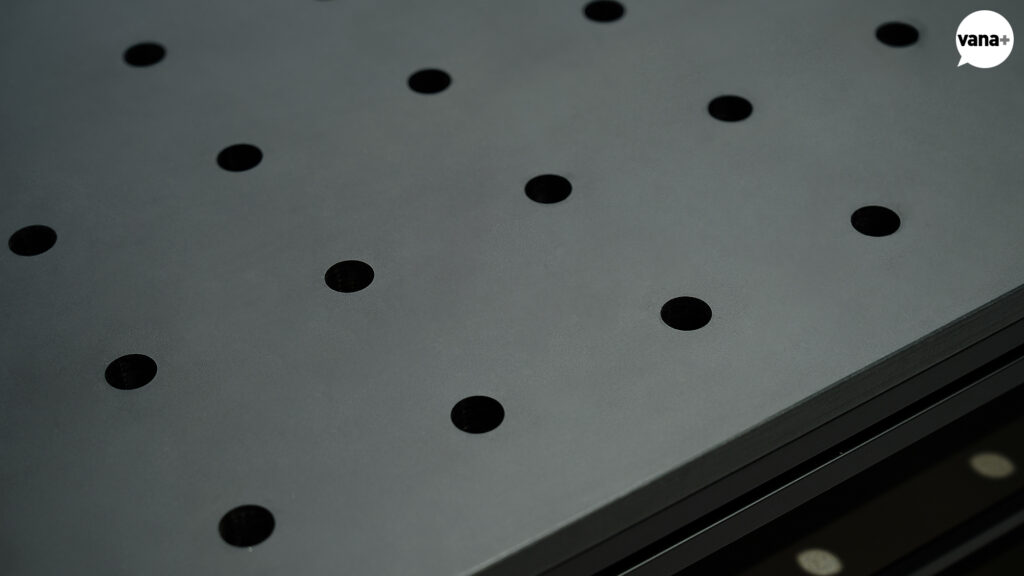
I used HPL-faced plywood for the top and side panels. Each side of an 18 mm birch plywood core is covered with 0.7 mm HPL, resulting in a calculated total thickness of approximately 19.4 mm—essentially a substantial 20 mm panel.
I considered using 0104 SM, a super-matte black, for the top, and 6618 TX, a dark gray with a more conventional sheen and relatively easy maintenance, for the sides.
Walnut veneer or exposed birch plywood would have given the workbench a natural appearance that openly expressed the presence of wood. The black-and-gray version instead resembled a piece of precision equipment or modern system furniture. I could picture it clearly: an object that would not quite match the familiar image of a woodworking studio. That was exactly what appealed to me.
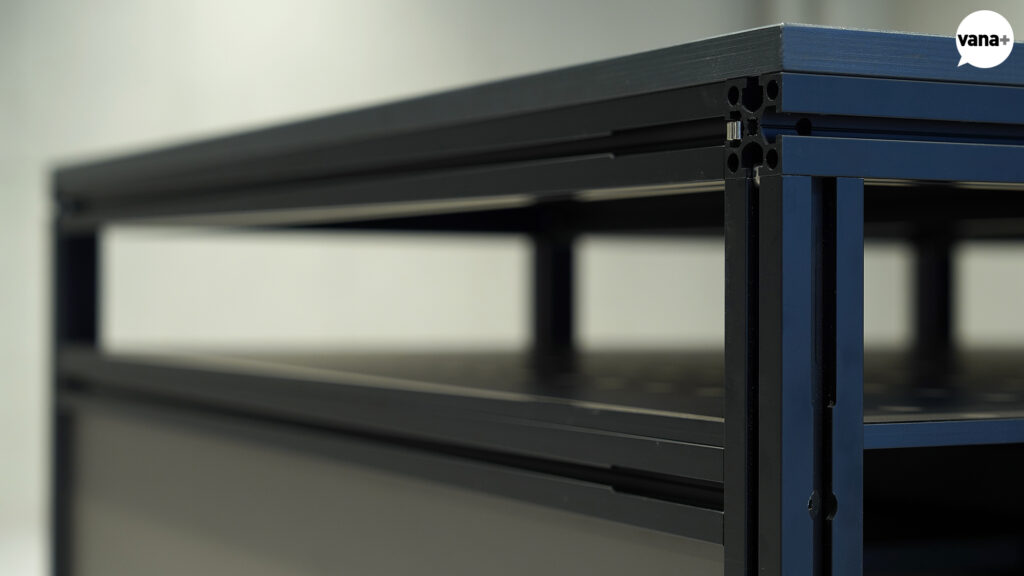
The frame was made from heavy-duty 40 × 40 mm aluminum profiles. To withstand hammering and support heavy workpieces, I decided that heavy profiles were more appropriate than the commonly used lightweight type. At this point, however, the sequence of fabrication became even more important than the color.
Black-finished profiles are already available, although they are not offered by many suppliers. But if a finished black profile is cut and machined afterward, the silver aluminum is exposed at every cut end and newly drilled opening. These may be small areas, but once the entire structure is black, they inevitably become more noticeable.
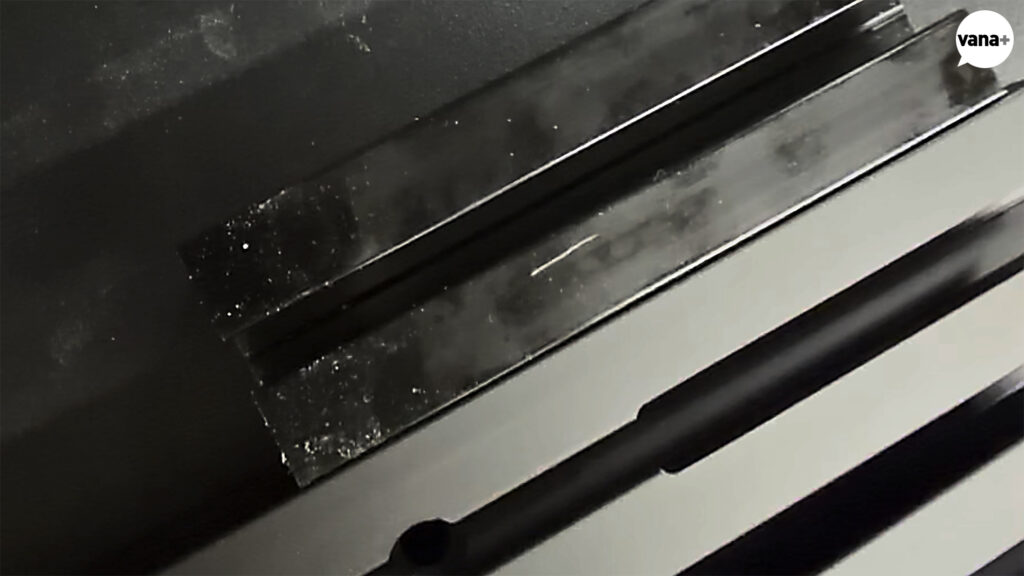
In addition to the coating rubbing off easily, the degree to which fingerprints remain varies considerably.
The quality of several black-painted profiles I purchased as samples was also concerning. The finish seemed likely to chip easily around the edges and fastening points. Some surfaces retained so many fingerprints that they quickly appeared stained.
I therefore ordered heavy-duty profiles in their standard silver finish, cut them to the specified dimensions, and completed every required machining process first. Only then were all the parts sent to a specialist for black anodizing. The intention was to carry the same finish through even the cut ends and holes that would rarely be seen.
This greatly increased both the cost and the number of fabrication stages. Even so, I expected the final result to look far more considered than a structure whose exposed areas had been touched up after assembly.
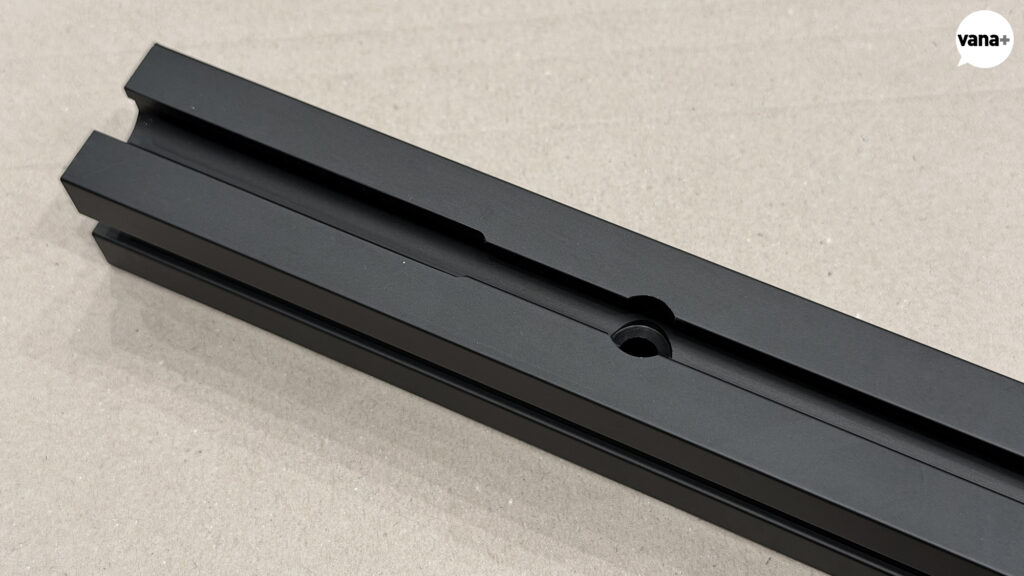
I applied the same principle to the other components wherever possible. The channels around the catch tray, drawer handles, drawer runners, casters, and power-outlet covers were all selected or finished in black.
The light-colored inner edges exposed by machining the MFT holes were treated with Bondex MATT 730 Ebony. The cut edges of the top were finished in Benjamin Moore Regal Select 2132-10 Black, while the edges of the side panels were finished in CC-542 Willow.
The goal was not to make every component exactly the same shade of black. Matte HPL, anodized aluminum, painted hardware, and oil-treated wood each respond to light in different ways. Instead, I wanted to narrow the overall range of colors so that the differences between materials would not interfere with the form.
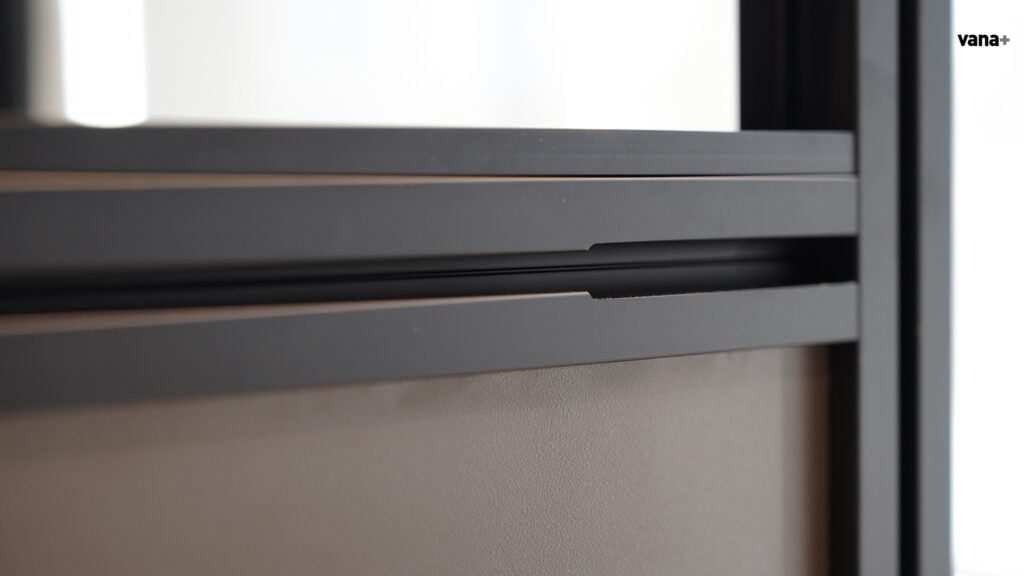
During this process, even selecting a single piece of hardware proved more difficult than expected. Side A, where the Systainers are arranged in two rows, required black drawer runners that were 700 mm long and capable of carrying a substantial load.
While searching for a product that met every condition and offered a dependable level of quality, I eventually ordered runners directly from Penn Elcom in the United Kingdom.
The product I chose was the R2428K Black Drawer Slide: a 45 mm-wide, 700 mm-long, full-extension ball-bearing runner. Penn Elcom’s official catalog lists its load rating as 45 kg per pair.
Nine pairs of these 700 mm runners are used on one side of a single workbench. During fabrication, we decided to build two identical workbenches, so I ordered eighteen pairs in total.
The products themselves cost approximately KRW 400,000, while shipping alone came to roughly KRW 550,000. And then, of course, there were customs duties and taxes.
Even on paper, it looked like an absurd order. Once I tried moving the boxes after they arrived, however, the ridiculous shipping cost began to make a little more sense. They were so heavy that I could barely lift even part of the shipment on my own.
At the time, I was furious with the gentlemen in Britain who effectively responded to my email protesting the unbelievable shipping charge with, “Well, cancel it then…” Looking back now, I feel just slightly sorry about it.
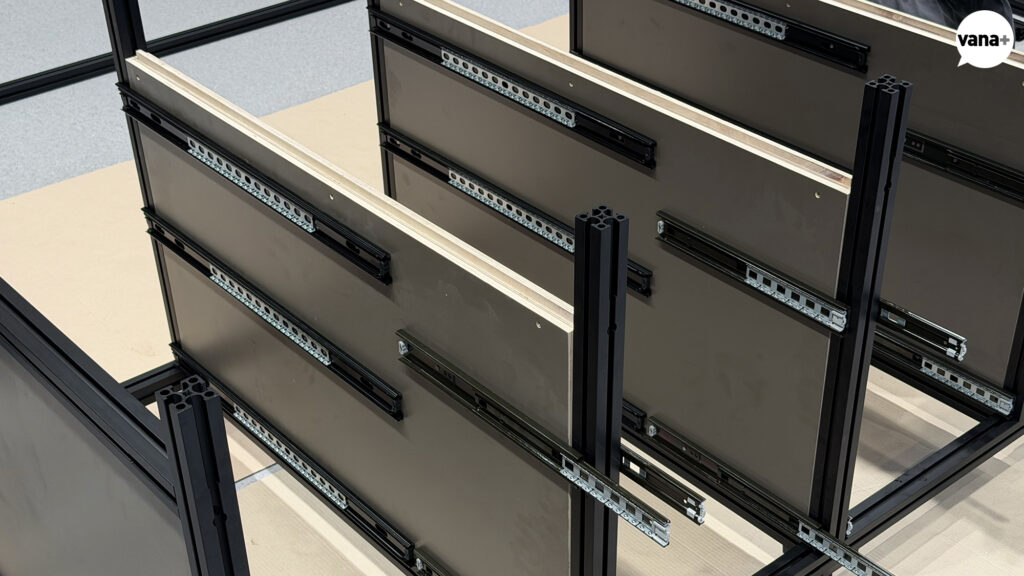
All are finished in black.
For the remaining drawers, I used black runners from Häfele. These came in two lengths, 350 mm and 400 mm. Both are 45 mm-wide, full-extension ball-bearing runners rated to carry 40 kg per pair.
This incident—if it can be called that—captures the character of the workbench rather well. I spent an unreasonable amount of time considering even the drawer runners, which would barely be visible, and that decision consumed both a great deal of money and an extraordinary amount of time.
Was it really necessary to go that far? There were certainly other perfectly acceptable answers. Still, once I had established the conditions for the project, I chose not to compromise them halfway through.
MATERIALS & FINISHES
FRAME
40 × 40 mm heavy-duty aluminum profiles / Black anodized after all cutting and machining
WORKTOP
18 mm birch plywood with 0.7 mm HPL on both faces / 0104 SM Super Matt Black / MFT-hole edges treated with Bondex MATT 730 Ebony / Cut edges finished with Benjamin Moore Regal Select 2132-10 Black
SIDE PANELS
18 mm birch plywood with 0.7 mm HPL on both faces / 6618 TX Dark Grey / Edges finished with Benjamin Moore Regal Select CC-542 Willow
DRAWER RUNNERS
- Penn Elcom R2428K / Black / 45 mm wide / 700 mm long / Official catalog load rating: 45 kg per pair
- Häfele / Black / 45 mm wide / 350 mm and 400 mm long / Full-extension ball-bearing runners / Load rating: 40 kg per pair
POWER OUTLETS
JUNG LS 990 Series / Black / JUNG dedicated orange plastic flush-mounting boxes (exact model number to be confirmed)
CASTERS
Foot Master GDN-60F / Black / Heavy-duty leveling casters with a load capacity of 250 kg each
POWER CABLE
Dongyang 4 sq mm × 3-core flexible matte-finish high-capacity power cable (VCT, IEC-53)
From Modeling to the Actual Build