

WORKBENCH CONCEPT
Planning a Workbench of My Own
I had been woodworking for just over a year when I decided to design a workbench for myself.
There were already plenty of well-made products on the market, along with traditional designs that had been proven over generations. Still, I wanted to reconsider the whole thing from the beginning. Given my limited experience, it may well have been a project I should have attempted much later.
After all, I had only used a handful of workbenches. I was hardly in a position to analyze the shortcomings of existing designs with any real expertise. I could not confidently say what height would work well across different tasks, or what kind of structure would remain solid and dependable after years of use.
But after spending time on various projects at the woodworking studio, one thing had become clear: the workbench I wanted to use in the future needed to be a little different from the ones I had used so far.
“THE WORKBENCH IS WHERE WOODWORKING BEGINS AND ENDS.”
I heard this many times while learning woodworking, and in more YouTube videos than I can count. At first, it sounded a little exaggerated. Cutting and joining wood requires all kinds of woodworking machinery and tools—and there are so many extraordinary tools out there. Surely a workbench only needed to be a large, sturdy table on which to place a workpiece and use those tools.
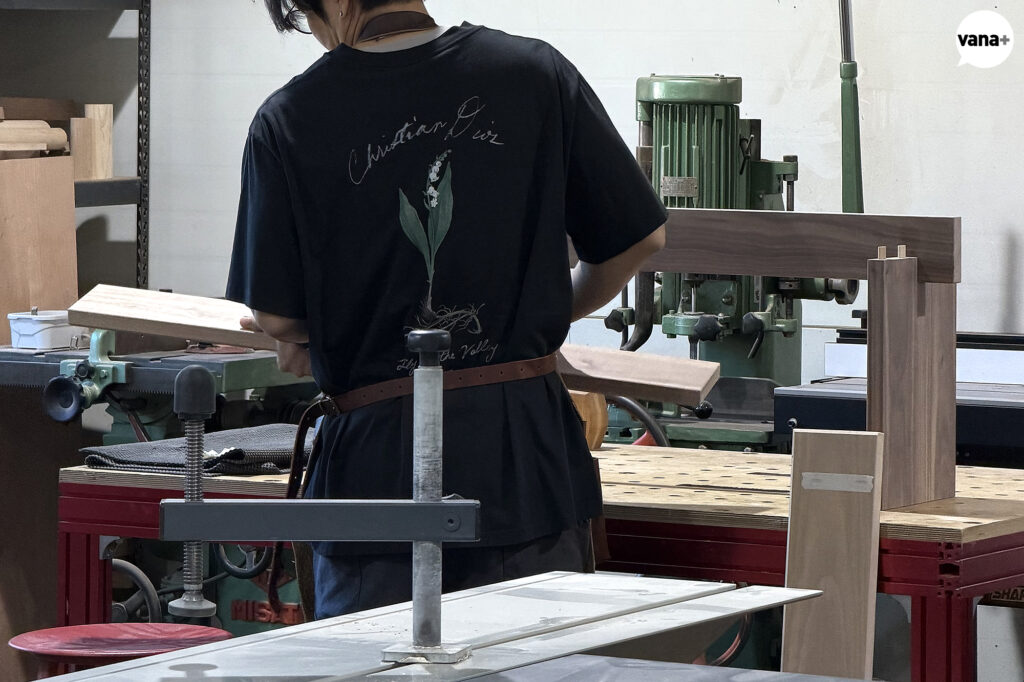
But once I began working with one, I realized that a workbench plays far more roles than I had expected. The flow of a task changed depending on where the material was secured, from which direction a tool was taken, and where a tool was set down for a moment. The width and depth of the bench affected how I moved around it. Even the open space underneath and the apron had their own uses; every part of it found a purpose, down to a corner where I could hang a pair of oily gloves after taking them off.

The woodworking studio I attend has several different types of benches, and the same task can unfold quite differently depending on their structure and form. I still could not clearly explain what made a workbench good, but I was beginning to understand the kind of inconvenience a workbench could create when it did not suit me.
It was not that I had ignored the products already available. If a good product exists, I would rather buy and use it. I am not diligent enough to make everything myself simply to satisfy my own preferences.
For quite a long time, I researched traditional European workbenches, multipurpose tables with MFT tops, cabinet-style benches focused on storage, and even products that could be customized to some degree. Each had its strengths, but I ultimately found nothing that met all of my requirements.
What I wanted was not simply a large, sturdy table.
- A generously sized perforated top that would naturally accommodate Festool woodworking tools and MFT accessories
- Storage that could hold my growing collection of Systainers while keeping them convenient to use, rather than merely putting them away
- Open space beneath the top, allowing access to the underside of the MFT holes
- Systainer storage accessible from both the front and rear, along with separate drawers for measuring tools and other small items
- An aluminum-profile structure with clamping points—or separate vises—on every side
- Power outlets kept close at hand, with cables and sockets arranged as discreetly as possible
- A modular structure that could later connect naturally to a Saw Bench, Router Table, and other additions
- An appearance that offered plenty of functionality while remaining calm enough to look like a piece of furniture in the workshop
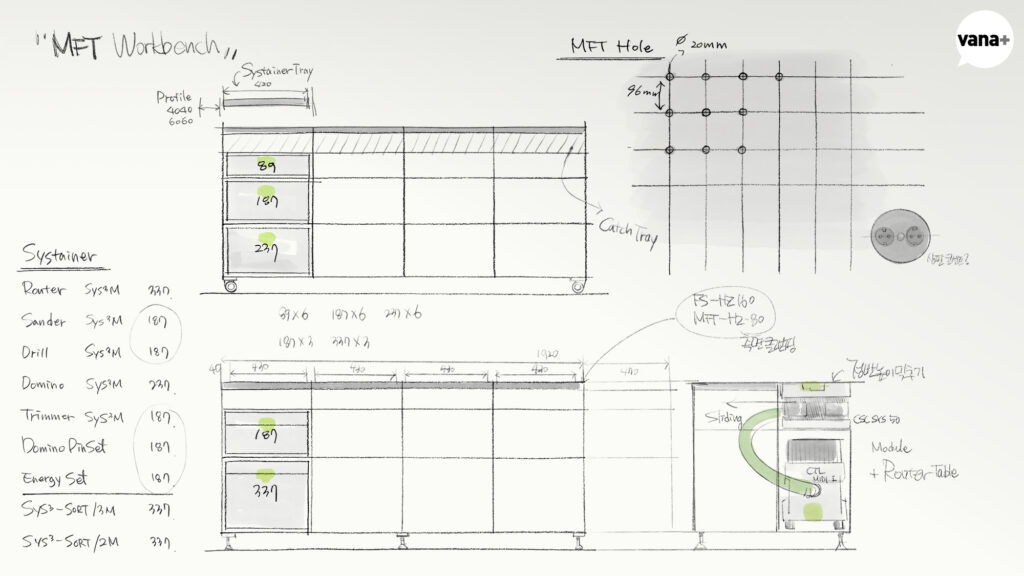
None of these requirements was particularly unusual on its own. MFT tops, Systainer drawers, and aluminum profiles are already widely used in woodworking benches. The heart of this project was not to invent a new component or create something the world had never seen.
It was closer to selecting the existing ideas that suited the way I work, then arranging them neatly within a single bench so they would not interfere with one another.
Although I am still very much a beginner, with only a little over a year of hands-on woodworking experience, this was not the first time I had tried to turn an idea into a physical space or object. I had designed buildings for galleries and ateliers and seen several of them constructed. I had also worked with professionals on multiple renovations of the home I live in. Along the way, necessity led me to design and model dozens of pieces of furniture that are still in use today.
Compared with architectural design, furniture can be approached on a much smaller and less complex scale. I have also loved furniture, lighting, and designed objects for a long time, and have steadily bought and lived with many of them. If nothing else, I had developed a reasonably clear sense of what I liked.
Of course, there were also moments when ambition ran ahead of experience. Had I focused only on the necessary functions, the bench could have been much simpler and easier to build. But because it was something I would make for myself and use frequently, I wanted to be demanding and do it properly. As I paid attention to one detail after another, even the preparation period became remarkably long.
Perhaps what mattered most in allowing me to pursue this strange project was having the mental freedom not to prove its usefulness immediately.
I was not doing it for money or as part of my job. Nothing disastrous would happen without it. That freedom allowed me to spend a very long time thinking about something simply because I wanted to.
I believe creativity can emerge from unhurried, seemingly unnecessary time. By holding on to questions that would never have arisen if efficiency were the only concern, and by deliberately reconsidering something that was already perfectly usable, something creative may occasionally emerge.
Anyway,
This series is not being written merely to show a finished workbench. I want to record why I decided to make it, what I studied along the way, which conditions I kept or abandoned, and what kinds of thoughts—useful or otherwise—went into the process.
I intend to focus more on the process than the result, so that when I look back years from now, I can still remember each decision.
PROJECT BRIEF
PROJECT GOAL
A custom workbench for an individual woodworker whose workflow centers heavily on Festool tools and Systainers
KEY FEATURES
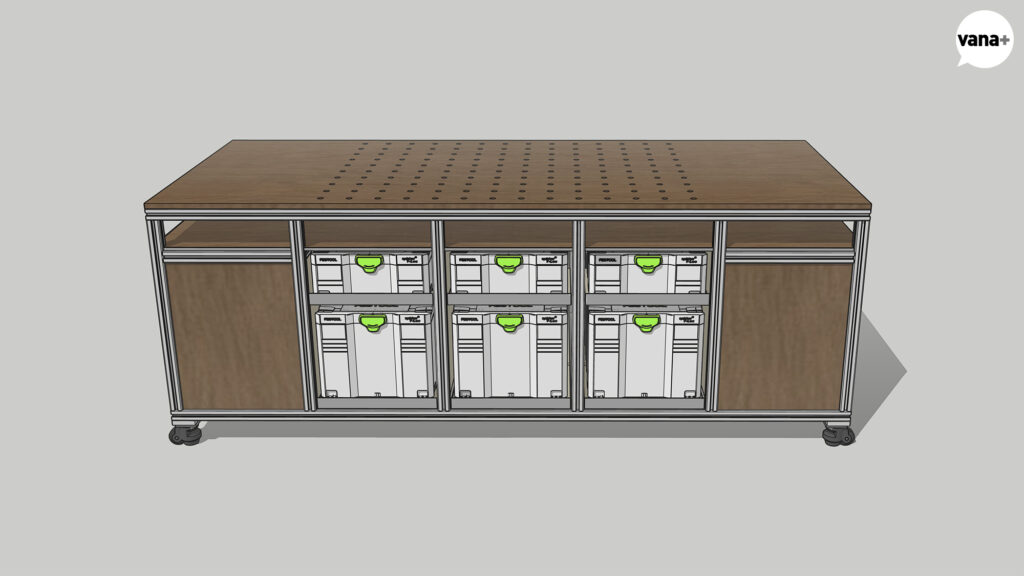
- A large MFT work surface
- Storage for numerous Systainers
- A catch tray for temporarily holding workpieces and providing access to MFT accessories from beneath the top
- An aluminum-profile structure that also makes the sides usable
- Power outlets positioned close to the work surface while remaining as visually discreet as possible
- A base that supports both mobility and complete stabilization
- A structure designed with long-term modular expansion in mind
DESIGN TOOL
SketchUp
FABRICATION PARTNER
WOOS
PLANNED EXPANSIONS
- Saw Bench
- Router Table
- MFT interface accessories
Traditional Workbenches and Modern Modular Structures