

DESIGN REFERENCES
Traditional Workbenches and Modern Modular Structures
Whenever I become interested in an object, I have a habit of tracing it back to its roots.
When I know what I want but cannot find a product that feels right, I sometimes stop comparing what is currently on sale and look instead at the original form—the point where that type of object began.
That was how the workbench project started. Unable to find a modern workbench I truly liked, I kept moving backward through its history until I arrived at the massive woodworking bench documented by André Jacob Roubo (1739–1791).
A woodworking bench from eighteenth-century France was, by that fact alone, almost perfectly suited to my taste. I loved its weighty structure and form, but bringing that same object into my own workshop presented more than a few practical problems.
At first, I looked for a contemporary workbench with a modern appearance and a strong structure. A modern woodworking studio—unsurprisingly, the search did not go particularly well.
So I changed direction slightly. Instead of continuing to compare products currently on the market, I began by examining how woodworking benches had been built and used over a much longer period.
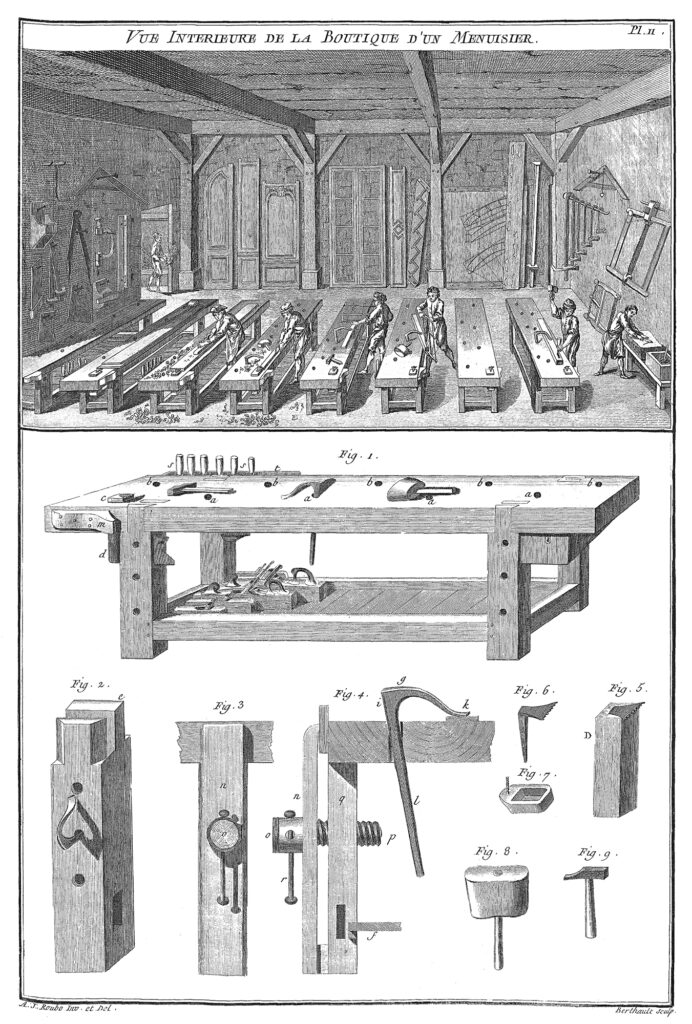
The Roubo workbench has a thick top, substantial legs, and a structure designed to hold large pieces of timber securely. It is simple, but its purpose is unmistakable. More than anything, it carries the weight of a design that seems to have proven itself through generations of use by working woodworkers.
In terms of form alone, it suited my taste far better than many contemporary benches with awkwardly varied proportions. The bold thickness of its top and legs gave it structural stability while also creating a kind of simple architectural beauty.
But when I considered actually making and using one, the same thick, heavy structure that had seemed so appealing became a serious obstacle. Importing one was hardly imaginable. Building one properly in Korea appeared to require considerable material resources and fabrication experience. Finding someone capable of producing it in the way I wanted would not be easy either.
More importantly, the woodworking I intended to do involved modern tools that an eighteenth-century bench was never designed to accommodate. Forcing contemporary working methods into a historical structure simply out of respect for tradition and form began to feel like a rather strange choice.
Instead of producing a half-hearted imitation of a traditional workbench, I decided to move all the way in the opposite direction.
What I would carry forward from its heritage was not its literal heavy appearance, but its attitude: a structure that remains solid and dependable throughout the work. Its construction, meanwhile, would be updated to suit contemporary tools and storage.

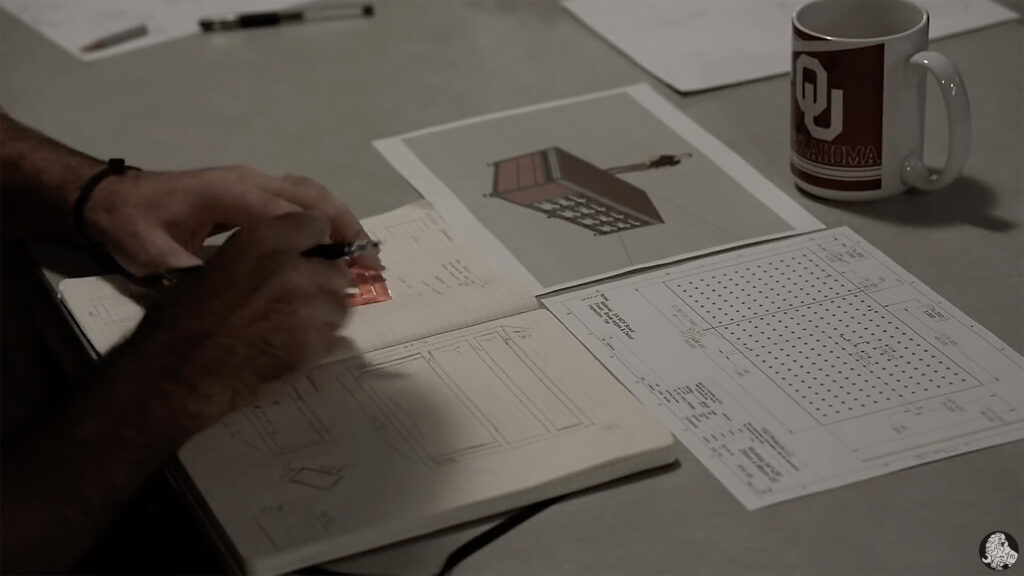
Around that time, I came across an intriguing workbench in a YouTube video from The Garage Journal. Its maker explained that the idea began with the aluminum structures and modular designs he saw in laboratories during a visit to the Johnson Space Center. That interest eventually led him to the work of Tom Sachs, whom he described as something of a “screw nerd.”
The result was a large 4 × 8 ft (approximately 1.22 × 2.44 m) MFT workbench built from 80/20 aluminum profiles. In The Garage Journal’s own description, it was essentially a 4 × 8 ft MFT table with a great deal of storage.
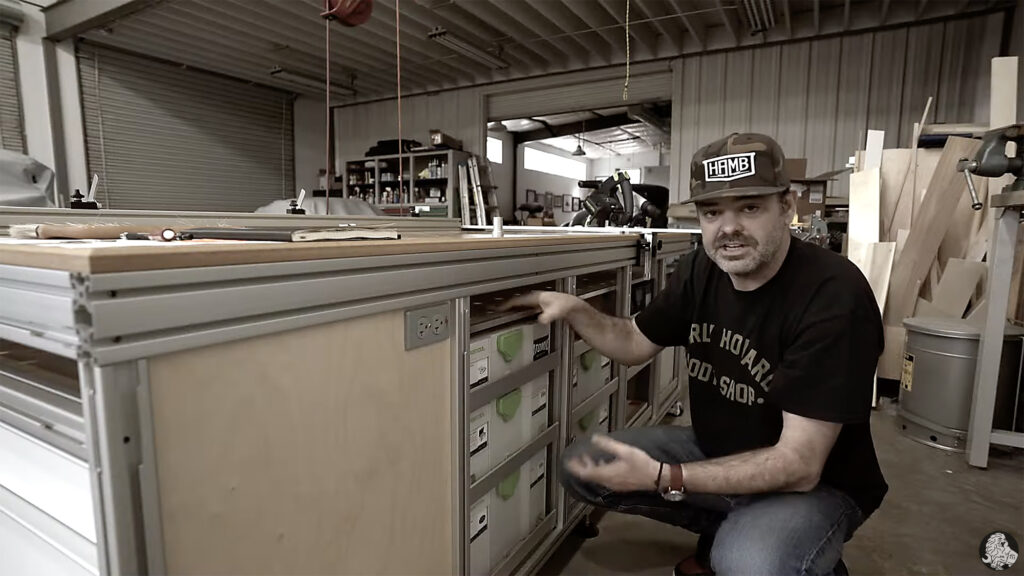
Oh. This was remarkably close to the direction I had been looking for.
The structure could achieve the necessary rigidity without occupying as much volume as a timber frame, leaving the interior available for storage. That also made it well suited to a workshop with limited space. The standardized slots in the profiles made it easier to add components or change their positions later.
For someone attempting to make a workbench of his own, the videos offered an exceptionally valuable record of practical fabrication experience.
However, it was not a project accompanied by finished drawings or detailed plans. I had to pause the videos repeatedly and infer how the frame was joined, how the drawers related to the top, and how the lower structure was assembled.
I captured the cross-sections and assembly sequences that appeared briefly on screen, then rebuilt the overall proportions in SketchUp. Someone with extensive experience in woodworking or aluminum profiles could probably have imagined all the omitted details immediately. I had to interpret them one by one, through a great many attempts and mistakes.
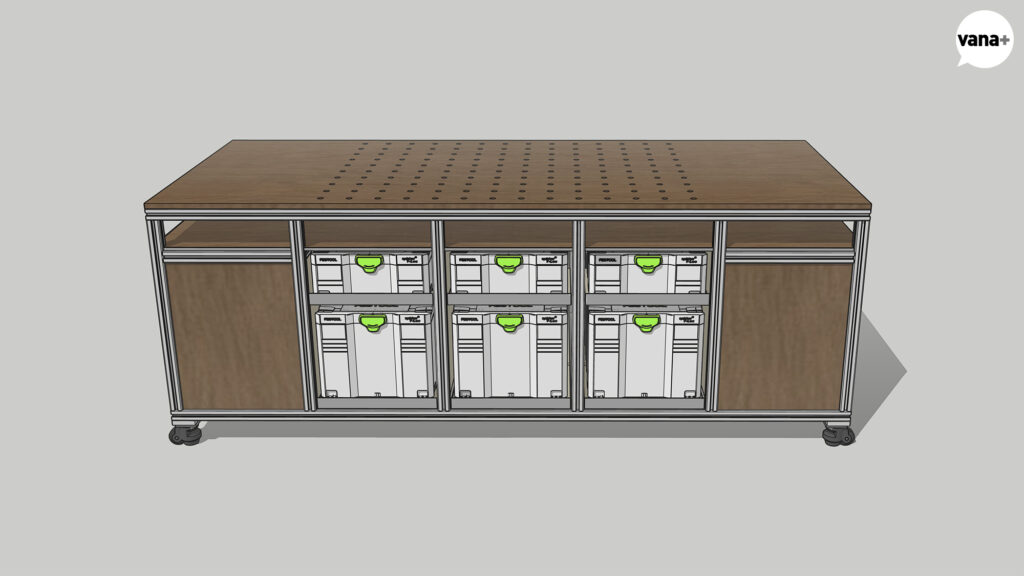
From this point onward, the process was less an act of copying than one of translation.
I used The Garage Journal’s central idea as a starting point, then redrew the structure around the dimensions and number of Systainers I owned, my preferred working height, the layout of the room, the catch tray and power system, and the modules I planned to build later.
My MFT workbench is a project that probably would not have happened without The Garage Journal. Its creators are unlikely ever to find their way here, but I would still like to express my thanks.
STARTING POINTS FOR THE DESIGN
ROUBO WORKBENCH
A solid, stable structure capable of serving as the center of the work
THE GARAGE JOURNAL 4 × 8 MFT WORKBENCH
An aluminum-profile modular frame and a systematic storage arrangement for Systainers
REFERENCES
Functions and Structures Shaped Around the Way I Work