

SYSTEM PLANNING
A DUST COLLECTION SYSTEM OUTSIDE THE WORKSHOP
atelier summer will eventually become a personal space with several different purposes, but for now, its primary role is that of a woodworking workshop.
When people picture a woodworking shop, they usually imagine sawdust drifting through the air and heavy tools scattered around in a somewhat rough and utilitarian setting.
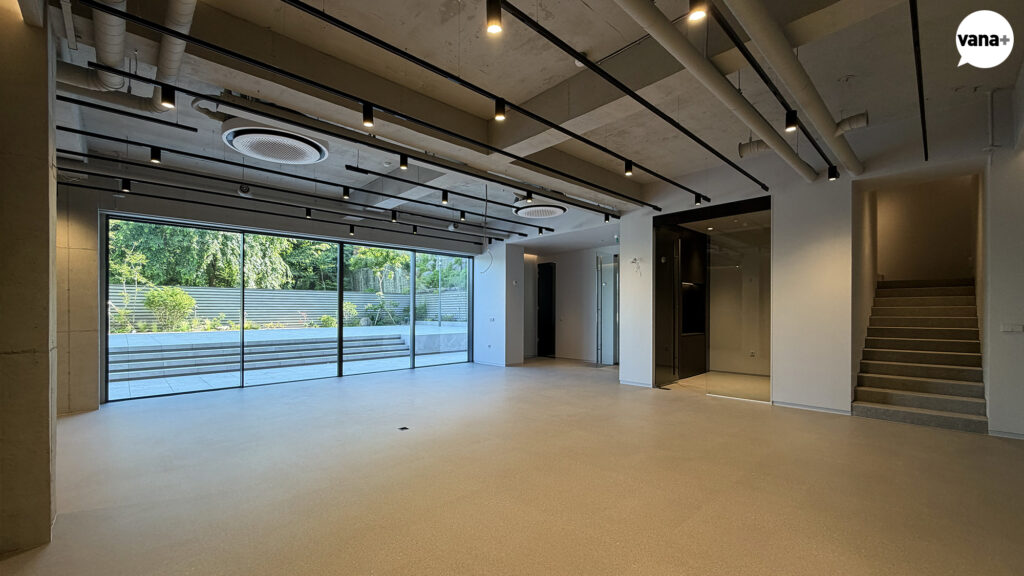
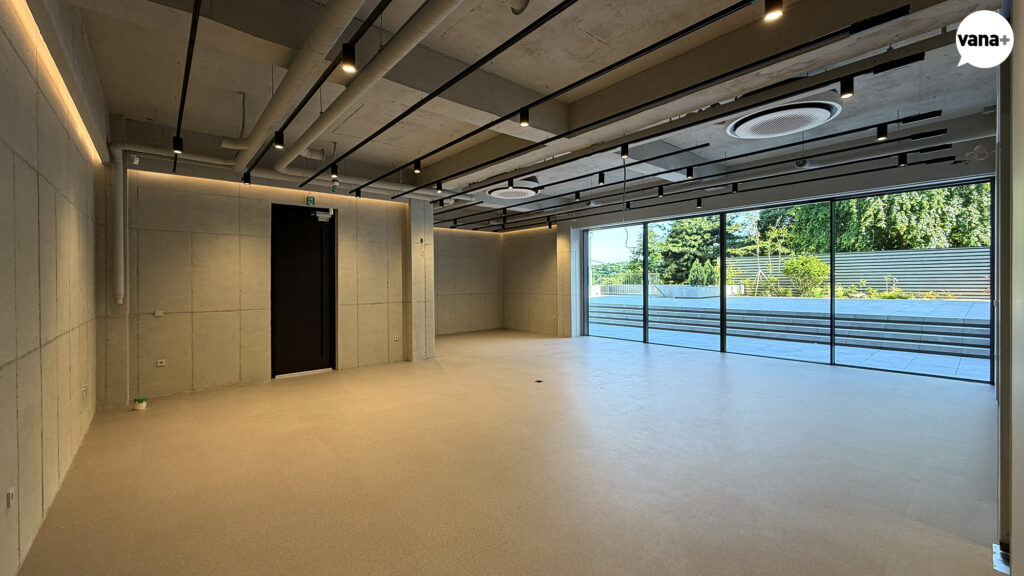
There is a certain charm to that kind of workshop, of course. But I wanted the atelier I was creating to feel a little different. In fact, it did not necessarily have to look like a “woodworking” space at all. What if it could simply be a well-planned modern workshop—an atelier with a calm, substantial presence as an interior space in its own right?
But as I began working through the layout of the woodworking machines, I realized that dust collection might be the biggest obstacle to creating that kind of atmosphere.
If every woodworking task could be handled using only Festool equipment—which takes dust collection very seriously—there would have been much less to consider. But even the basic process of preparing solid lumber makes it difficult to avoid using larger stationary machines.
Sawdust and airborne dust are unavoidable parts of woodworking, so a proper dust collection system is less an option than a necessity. Unfortunately, the kind of dust collection setup commonly associated with a woodworking shop is rarely pleasant to look at. A large dust collector may occupy one side of the room and interrupt the workflow, while thick hoses and pipes stretch across the space and become tangled in every direction.
And appearance is not the only problem.
There is the tremendous noise, loud enough to make conversation difficult. Then there are the blast gates that must be opened and closed every time you move from one machine to another, repeatedly interrupting the flow IRequest of the work.
I am not an expert, so no particularly clever solution came to mind at the outset. But since I had the opportunity to shape the space from the architectural stage onward, I decided to explore whether I could create a dust collection system that worked well both functionally and visually.
It did not seem likely to be easy.
This was not simply a matter of connecting a few pipes. I had to consider how the system could collect dust efficiently while remaining as unobtrusive as possible—and whether it could also look clean, orderly, and intentional. At that point, I was not even certain that all of this could be achieved.
It may sound unnecessarily particular, but I believe that details like these ultimately improve the quality of the work and help make a hobby sustainable over time. So I decided not to compromise and to be just a little more particular about it.
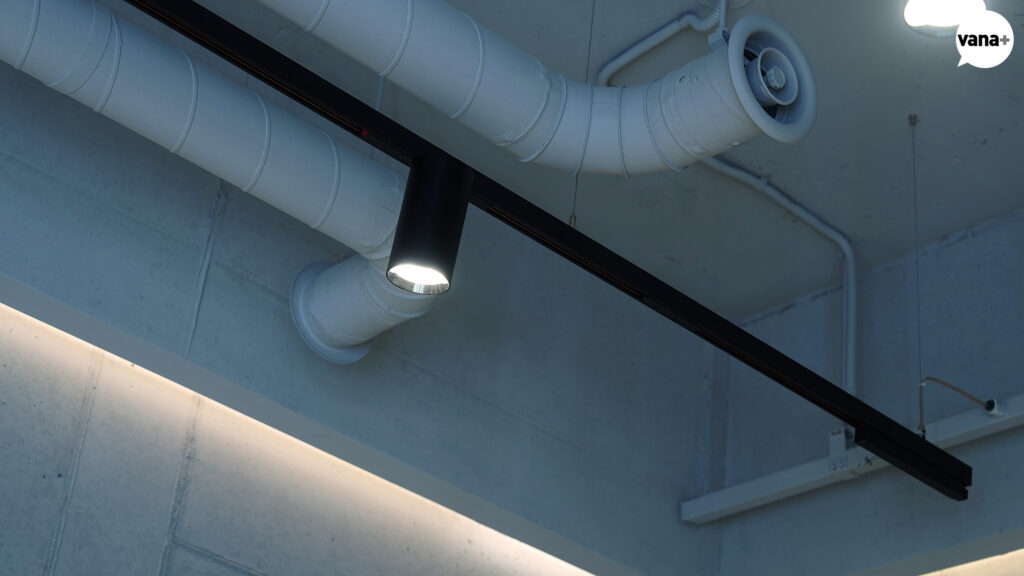
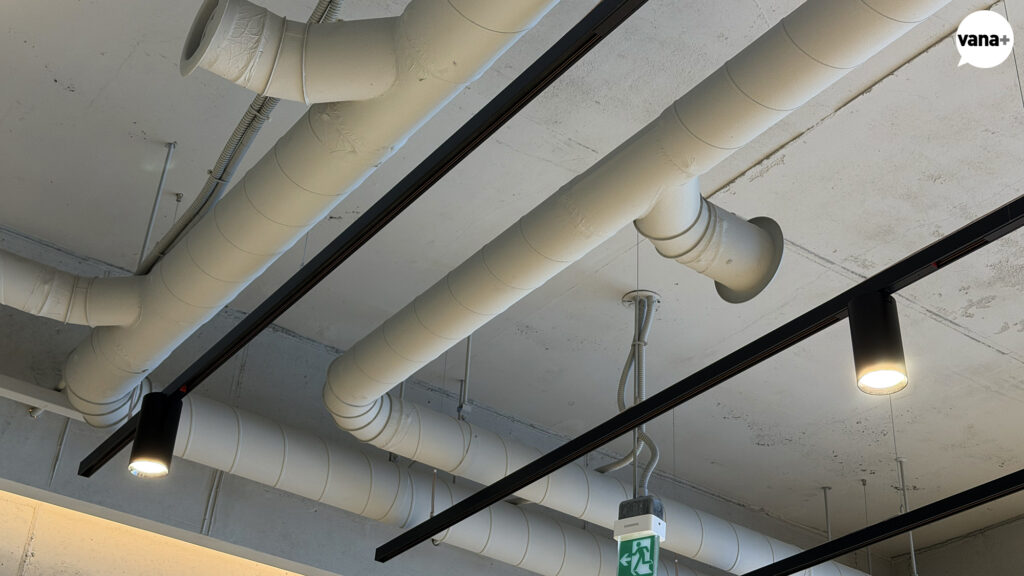
Separate from the dust collection system discussed directly in this article, the entire first floor is equipped with a forced-ventilation system and an additional heat-recovery ventilator. All of their ductwork has been aligned along the ceiling.
These systems are intended to maintain ventilation and air circulation throughout the workshop, independently of the equipment that collects sawdust and wood dust directly at the source.
The trays for the ceiling lights and electrical equipment, the various ducts, and even the threaded rods supporting them were all painted to match the ceiling. That was another small example of just how particular I decided to be.
The first decision was where to place the woodworking dust collector.
Connecting several large woodworking machines to a single system naturally requires a dust collector of a certain size and capacity.
The problem is that powerful dust collectors are usually both extremely loud and physically enormous. If one is placed inside the workshop, it occupies valuable space. No matter how neatly the ductwork is arranged, the large machine itself remains impossible to ignore.
So I planned a completely different solution from the architectural stage onward.
I would remove the dust collector from the workshop altogether.
Instead of placing it on the first floor where the woodworking would take place, I created a separate dust collection room in the basement. During construction, ductwork connecting the basement to the first floor was installed in advance.
This eliminated the need to reserve workshop space for a large dust collector. More importantly, it physically separated the biggest source of noise from the working environment.
In the photograph, all that can be seen are two pipes rising from the floor. But because this would be difficult to change once the building was complete, it had to be decided during the design stage.
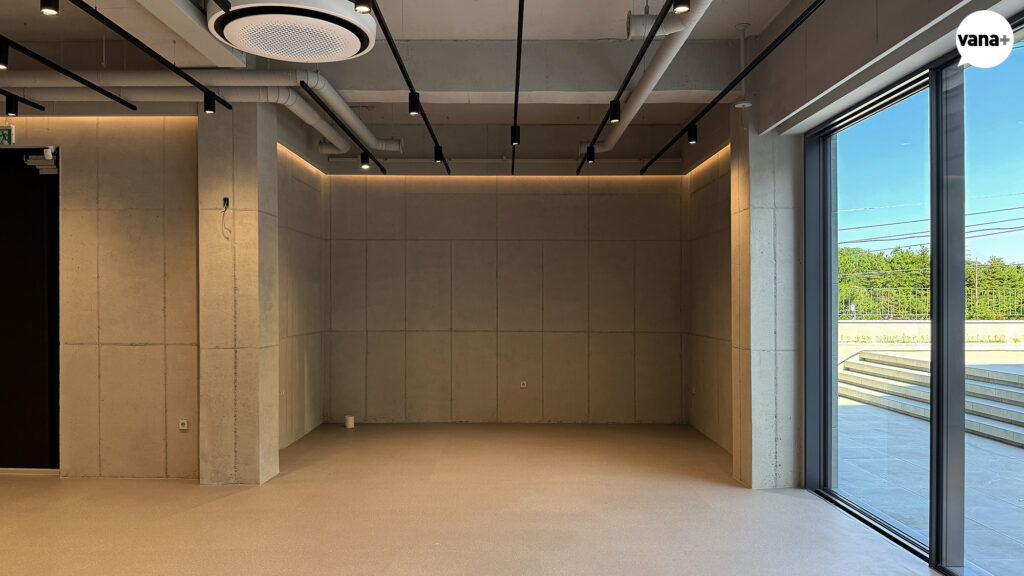
The dust collection inlet prepared in advance can also be seen near the floor.
Ultimately, two dust collection lines were installed between the first floor and the basement.
One is the main dust collection line that will connect the large woodworking machines.
The other is a Floor Sweep line, allowing small chips and dust on the floor to be swept directly into the system.
The large, noisy machine would remain one floor below, while only the necessary ductwork would be visible in the workshop.
That was the first major direction I established for the entire dust collection system.
Having made the biggest decision through an architectural approach, I assumed that everything after that would be relatively simple.
In fact, what came next turned out to be the much greater challenge.
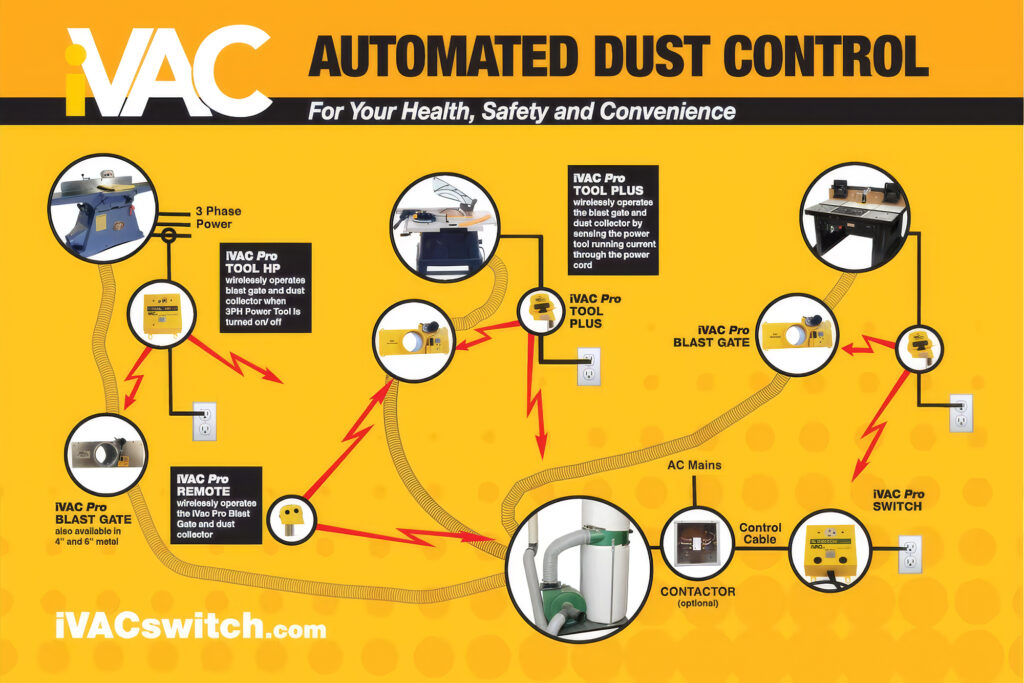
The airflow a dust collector can generate is limited. If every inlet remains open at the same time, the suction is divided among them and the efficiency of the system drops dramatically.
This means that the operator must close all the ducts connected to machines that are not currently in use. Only then can sufficient suction be concentrated where it is actually needed.
The usual solution is to install a device called a Blast Gate in the duct connected to each machine. The operator opens and closes it by hand, much like sliding a door.
The problem is that this process of opening and closing every gate by hand is incredibly tedious.
Every time a different machine is used, the appropriate gate must be opened and all the others closed, one by one.
It is certainly possible.
It is also extremely annoying. More importantly, this small but repetitive task continually interrupts the flow of the work.
I could not possibly be the only person bothered by this, and I was convinced that a solution must already exist. After a considerable amount of searching, I fortunately found one in North America, where woodworking systems of this kind are far more established.
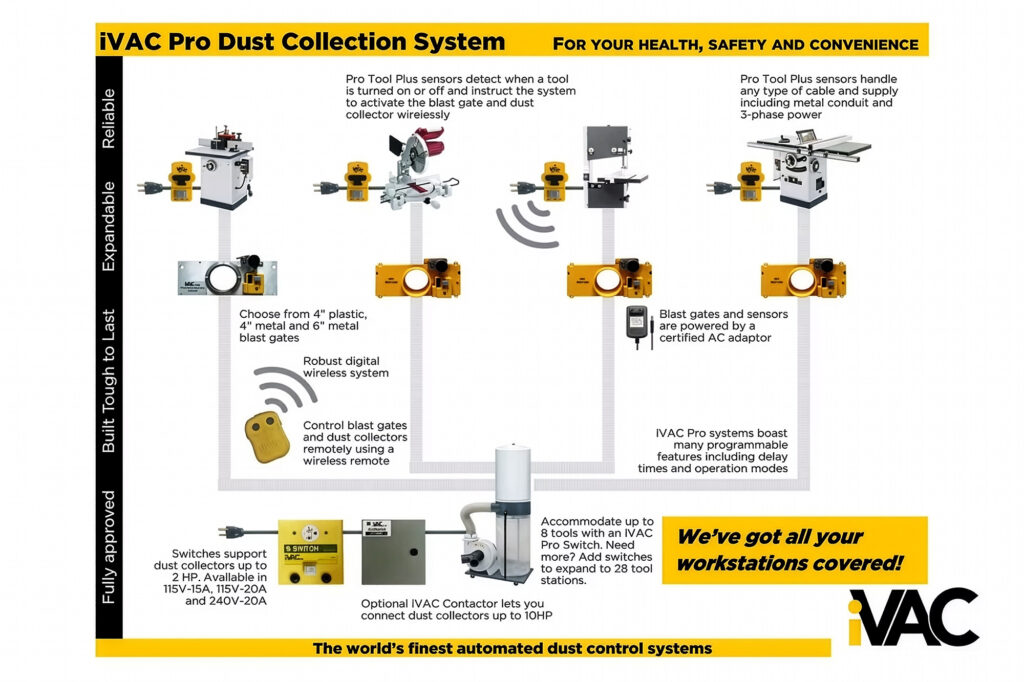
The solution I chose was iVAC—short for Intelligent Vacuum—which addressed precisely the problem I needed to solve.
As its name suggests, it is an intelligent dust collection control system. It connects multiple devices through a single network and automatically manages the entire process.
I did look for alternatives available in Korea.
There may well be more sophisticated systems, but most of the products I found were designed for industrial facilities on an entirely different scale.
At one point, I also considered using a pneumatic automatic gate proposed by a local company. But the pneumatic system itself was quite bulky and industrial-looking, which made it difficult to imagine in the kind of workshop I was trying to create.
In the end, iVAC appeared to offer the best balance between automation, modularity, and a scale appropriate for a personal woodworking shop.
The concept was straightforward.
When a woodworking machine is switched on, the system detects that it is running. The corresponding Blast Gate opens, the unused gates remain closed, and the dust collector in the basement starts automatically.
When the machine is switched off, the gate closes and the dust collector stops after the necessary delay.
In other words, all I would need to do is use the woodworking machine as usual. The dust collection system would take care of everything else.
This was exactly the kind of system I had been looking for.
It was modular enough to accommodate changes in the workshop, and it allowed each machine, gate, and controller to be added and configured individually. That would be particularly useful in a space where machines might be moved, replaced, or added over time.
Whether it would work as smoothly in practice as it did in my plan remained to be seen.
Still, the fundamental direction of atelier summer’s dust collection system was now clear.
The large and noisy dust collector would be placed in a separate room in the basement.
Only the necessary ductwork would remain visible in the first-floor workspace.
Several woodworking machines would share one dust collection system, and the appropriate gate and dust collector would operate automatically whenever a machine was used.
Any ducts and wiring that could be prepared during construction would be installed in advance.
That concludes the Planning & Concept stage.
Now I needed the devices that would make the plan actually work.
DUST COLLECTION AUTOMATION WITH iVAC